



BRITISH INTERNATIONAL SECTION & EUROPEAN SECTION
The international section at the Lycée Français in Bangkok
International sections offer highly motivated students top-level teaching in foreign language, literature and civilization. An opportunity both for foreign students integrated into the French education system and for French-speaking students with a solid grounding in a foreign language.

International section in secondary schools
What is an International Section?
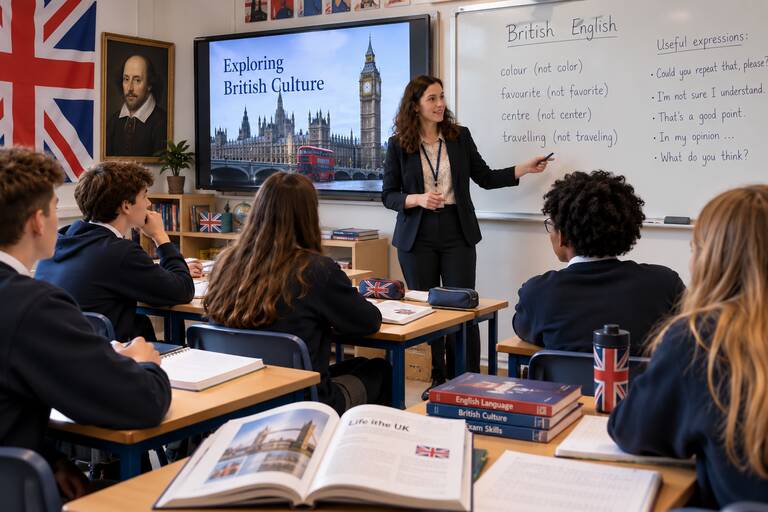
The international section offers bilingual teaching in a non-language subject. In addition to the timetable already dedicated to modern languages, another subject is taught in a foreign language.
What are the timetables for the International Section?
Students take all core courses as well as :
● 4 hours per week in British language and literature (study of English texts and books) ;
● 2 hours a week in English, history-geography and moral and civic education (including 1 hour taken from French history-geography teaching).
How do I get into the International Section?
To enroll in an international section, you need to apply and put together a file. The application will be examined by the International Section Council in June of the previous school year.
Why choose the International Section?
Students in the British International Section (SIB) learn to manage a particularly heavy workload and to prioritize.
Students who successfully complete this double curriculum develop the capacity for hard work, as well as the intellectual and cultural flexibility to become excellent undergraduates in the UK, France or elsewhere.
- Worth knowing:
The educational path in the international section is a demanding one, with a heavy workload and long hours. This pathway is therefore aimed at motivated students who are capable of sustained work and who read regularly.
- Worth knowing:
+ THB 22,000 tuition/year.
Tests specific to the International Section
● The DNBI (Diplôme National du Brevet “option Internationale”)
The Diplôme National du Brevet “option Internationale” comprises all the standard tests, plus two specific oral tests in language and literature, and history-geography. These two tests are conducted in the language of the section according to a schedule specific to the LFIB. The expected language level is B2 of the Common European Framework of Reference for Languages (CEFR).
● The IGCSE (International General Certificate of Secondary Education)
As the IGCSE Literature program is included in the SIB curriculum, students in LFIB’s international section can take the IGCSE Literature at the end of 2nde.
From 2025, families of interested students are invited to contact the British Council in Bangkok themselves to register for the exam.
The IGCSE is an English-language examination recognized in the UK as equivalent to the GCSE. It was developed by Cambridge University International Examinations.
● The BFI (International French Baccalaureate)
The program consists of the following courses:
*Cultural and Linguistic Deepening (ACL) English-language literature program, 4h30 in 1ère, 4h in terminale, with a written exam and an oral exam, coefficient 10 and 10 respectively.
*Connaissance du Monde (CDM) three main themes: thinking about society, living in the world, building the future, 2h in 1ère, 2h in terminale, with an oral exam, coefficient 20.
*Compulsory DNL in History and Geography, with a written exam and an oral exam, coefficient 10 + 10.
LCE-SELO Options
1. European Languages and Cultures – English (LCE) option
This optional course is offered during Cycle 4, from Cinquième to Troisième (equivalent to Years 8–10 in the UK).
The LCE course builds on the Cycle 4 English curriculum and is taught in English. It aims to deepen pupils’ understanding of the cultural topics explored in their compulsory English lessons.
2 extra hours per week.
2. The English European Section
For whom ?
The European Section is open to motivated pupils who wish to develop their proficiency in English, starting in Seconde.
At LFIB, two non-language learning subjects—mathematics and history-geography—are taught partly in English. In Seconde, pupils study both subjects. In Première and Terminale, they choose one of the two subjects.
Teaching in this section follows the current French national curriculum.
1 Extra hour per week.
Requirements for the European Section designation on the Baccalauréat diploma
The designation “European Section”, followed by the relevant language, appears on the Baccalauréat diploma.
To receive this designation, candidates must achieve:
– At least 12/20 in the modern language examination taken in the language of the section.
– At least 10/20 in a specific assessment of the work completed within the European Section.